

Two Countries, Two Very Different Futures for U.S. Global Health Cooperation
Bonus: More State Dept Funding Announcements

Tanzania has signed a new five-year health agreement. Zimbabwe remains outside the MOU framework after negotiations stalled. Together, they show the uneven direction of the new U.S. global health approach.
The United States is rapidly rebuilding its global health architecture after dismantling USAID and sharply reducing the traditional role of the Centers for Disease Control and Prevention. At discussed extensively, the centre of the new approach are bilateral health memoranda of understanding, or MOUs, negotiated directly between the State Department and partner governments.
As of July 15, the United States had signed 34 agreements. But signing an MOU is not the same as delivering health services. As congressional staff heard during a briefing this week, none of the agreements had yet become fully operational. Only a handful of detailed implementation plans were nearing completion, and those plans have not been made public.
This week, I wanted to focus on one bright spot and one not-so-bright spot: Tanzania and Zimbabwe. Together, they show the two sides of this new approach.
Tanzania signs a five-year agreement
Tanzania signed its five-year health cooperation agreement with the United States on July 1. After months of speculation whether there would even be an MOU, both sides moved swiftly to completion.
The financial commitment is substantial. The United States intends to provide approximately $1.34 billion between 2026 and 2030. Tanzania has committed more than $1.8 billion in domestic resources, bringing the combined package to more than $3.1 billion. Tanzania is expected to assume increasing responsibility for health workers, medicines and laboratory services by 2030.
There are still legitimate questions about whether Tanzania can meet those commitments and whether the transition timeline is realistic. Domestic financing projections are promises, not appropriations. Governments also face debt payments, limited tax revenue and competing health needs.
But Tanzania appears to have negotiated more deliberately than several other countries. Its government says biological specimens related to outbreaks and epidemics will remain stored, tested and governed inside Tanzania. The country did not sign a specimen-sharing arrangement. Tanzanian health data will remain subject to Tanzanian law and national health information systems according to statements released by the Ministry of Health (see below).
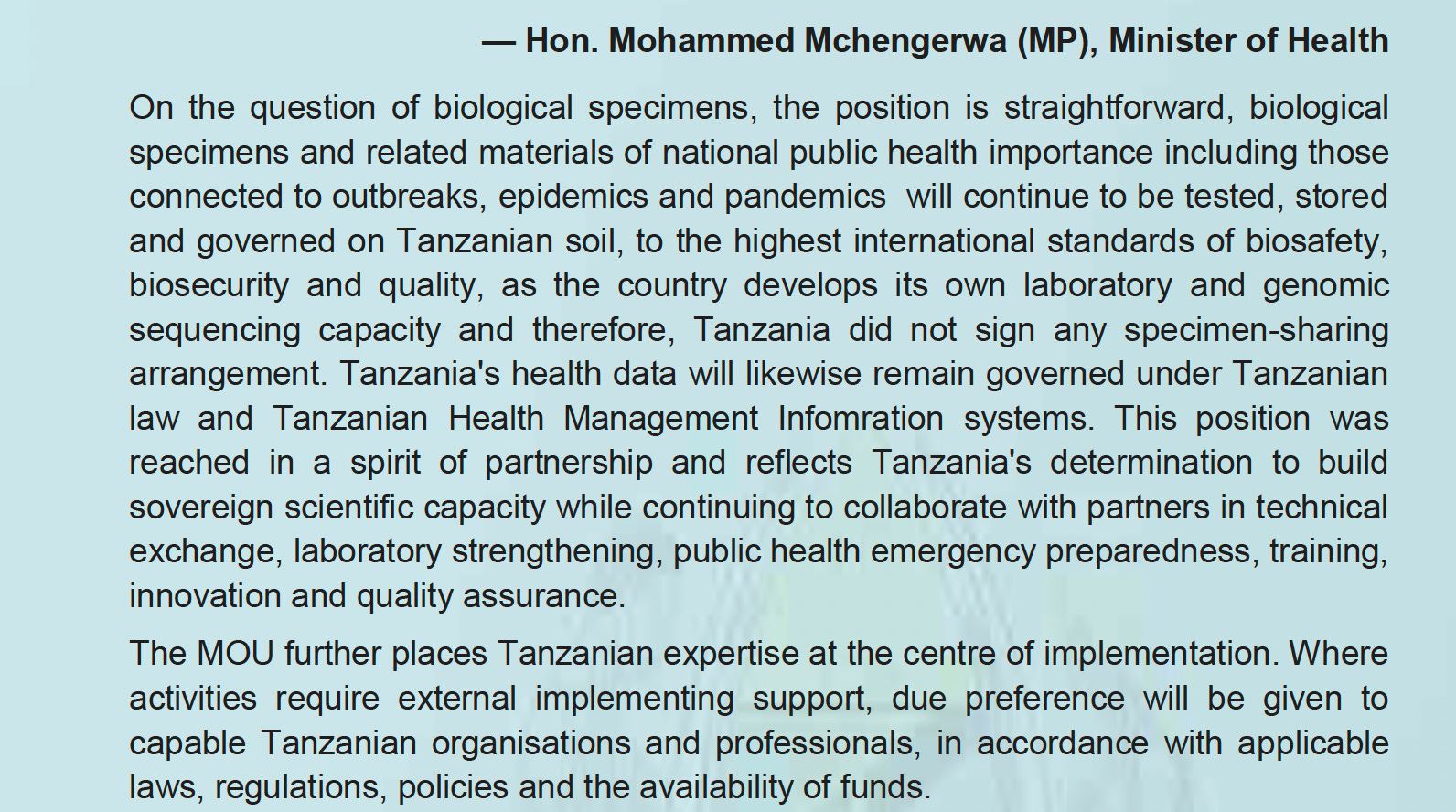
The agreement also gives preference to Tanzanian organizations and professionals when external implementation support is required. It seeks to strengthen the country’s Medical Stores Department and connect Tanzania with pharmaceutical manufacturing, logistics and technology-transfer opportunities.
Questions about pathogen samples, health data and national sovereignty have complicated negotiations elsewhere. Tanzania appears to have shown that governments do not necessarily have to choose between continued U.S. cooperation and surrendering control over sensitive national assets.
Still, the most important work lies ahead. The two governments must now produce an implementation plan detailing the programs, milestones, funding flows and responsibilities under the agreement. Until that happens, Tanzania has a framework, not yet a functioning transition.
Zimbabwe remains outside the framework
Zimbabwe took a different path. Negotiations over a proposed U.S. health agreement worth approximately $367 million collapsed in February after Zimbabwe raised concerns about access to sensitive health information and biological samples, as well as access to products developed using that data. The United States subsequently announced that it would end health assistance to Zimbabwe.
This is not a marginal country or a low-stakes dispute. Zimbabwe has reduced HIV incidence by roughly 80 percent since 2010. Its HIV response still depends heavily on PEPFAR and Global Fund support. Walking away without a credible replacement plan could quickly reverse those gains.
My Duke colleagues and collaborators from University of Washington, Georgetown, amfAR and Pangea Zimbabwe modeled what a complete PEPFAR withdrawal could mean if no replacement support were provided. Our central estimate was approximately 75,000 additional HIV infections within one year. That included about 19,000 infections linked to the loss of prevention programs, around 9,000 from reduced testing and delayed treatment, and more than 1,000 additional infections among children.
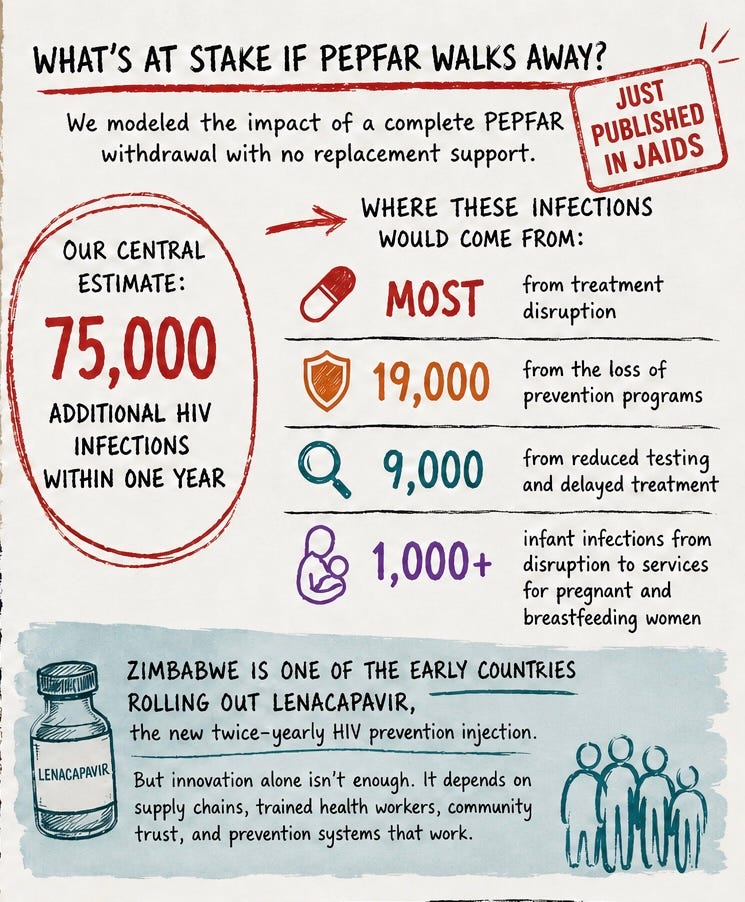
Zimbabwe is also among the countries expected to introduce twice-yearly lenacapavir for HIV prevention. Rolling out a major new prevention product while dismantling the broader treatment, testing, workforce and community infrastructure around it makes little sense.
The United States and Zimbabwe should return to negotiations. Both sides can protect legitimate sovereignty concerns without abandoning decades of public-health investment.
Friday Bonus: What the new APS addenda cover
The State Department has released seven new addenda under the Advancing Global Health Annual Program Statement.
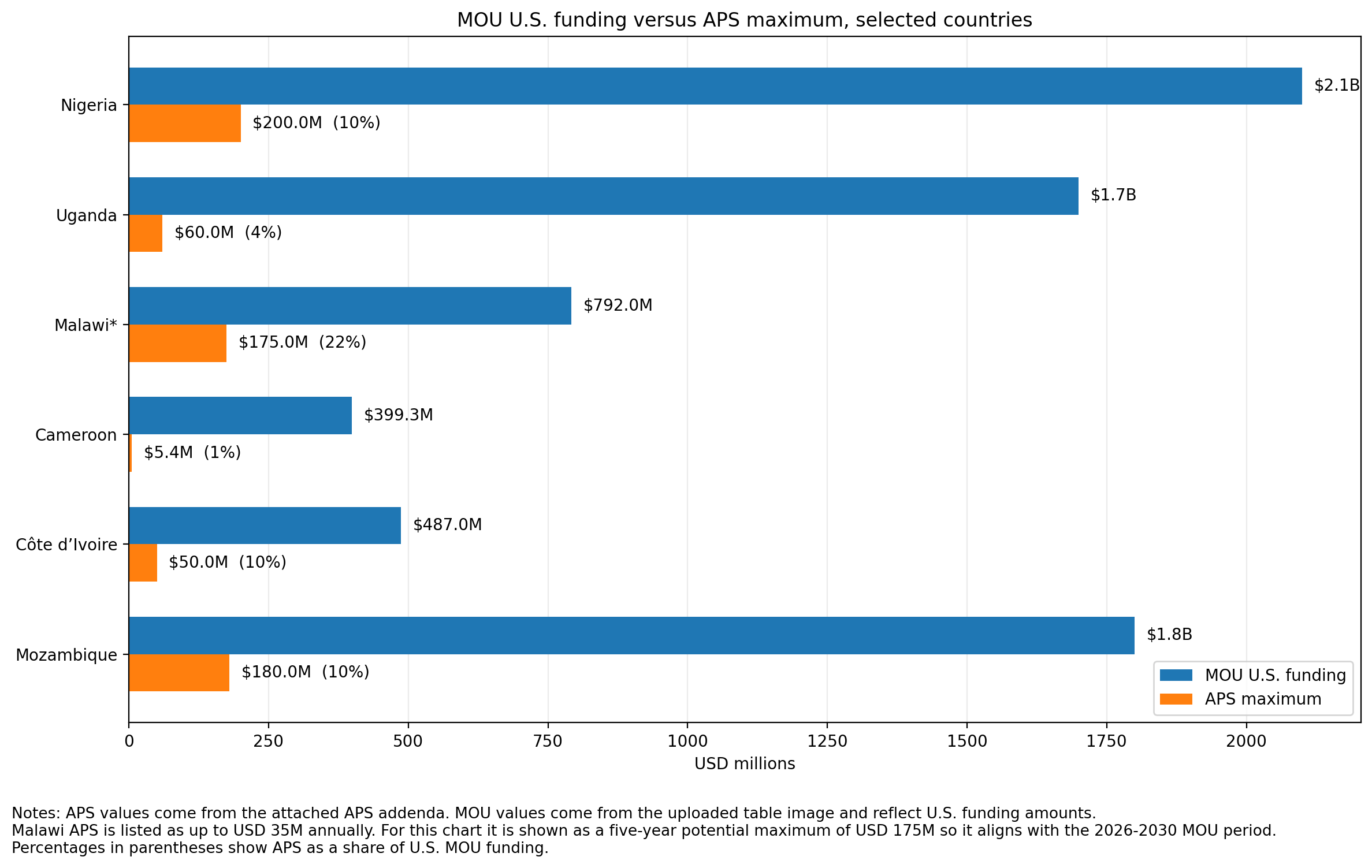
Six are tied directly to signed bilateral health MOUs. They cover Nigeria, Uganda, Malawi, Cameroon, Côte d’Ivoire and Mozambique. The seventh covers population-based surveys and surveillance across multiple countries.
These are funding opportunities, not awards. Organizations are being asked to submit Statements of Interest as the first step in a two-stage process. All funding remains subject to availability.
Nigeria: Up to $200 million across as many as 20 awards. The addendum supports the U.S.-Nigeria health MOU through December 2030. It covers HIV, tuberculosis, malaria, maternal and child health, immunization, nutrition, surveillance and outbreak response. It also includes faith- and community-based care, health insurance, digital systems and the transfer of health-worker costs to the Nigerian government.
Uganda: Up to $60 million across as many as 15 awards. This supports Uganda’s MOU implementation plan through December 2030. The work includes faith- and community-based services, digital health systems, power for health facilities, supply-chain tracking, district risk assessments and independent verification of government performance.
Malawi: Up to $35 million annually across as many as four awards. The addendum supports Malawi’s MOU implementation plan through December 2030. It focuses on moving service delivery and financing from implementing partners to government ministries, districts and the Central Medical Stores Trust. The work covers HIV, tuberculosis, malaria, immunization, maternal and child health, outbreak response, supply chains and health information systems.
Cameroon: Up to $5.4 million across as many as three awards. This is tied to Cameroon’s health MOU through December 2030. The focus is mainly health security, including surveillance, laboratories, emergency response teams, One Health coordination, infection prevention, supply chains, border health and cross-border information sharing.
Côte d’Ivoire: Up to $50 million across as many as three awards. The addendum is tied to the country’s health MOU through 2030. It seeks applications from local organizations and covers disease surveillance, laboratories, outbreak response, integrated services, district capacity and continued care through faith- and community-based facilities.
Mozambique: Up to $180 million across as many as 15 awards. This supports Mozambique’s MOU implementation plan through December 2030. It covers HIV, tuberculosis, malaria, maternal and child health, immunization, laboratories, data systems, supply chains, workforce transition, public financial management and government-to-government financing. It also includes support for national surveys, including a population-based HIV impact assessment.
Non country specific APS: Surveys and surveillance
The $80 million surveys and surveillance addendum seeks alternatives and improvements to established tools such as Demographic and Health Surveys, Population-based HIV Impact Assessments and TB prevalence surveys. It encourages novel sampling, routine data, new technologies, artificial intelligence and machine learning, and real-time surveillance.
That is an implicit acknowledgment that the emerging architecture still needs credible, independent data. Governments and donors cannot determine whether rapid transitions are succeeding by relying only on program reports or financial milestones. They need population-level evidence showing whether infections, deaths and inequalities are rising or falling.
The APS announcements are therefore meaningful progress. They begin to put operational detail behind agreements that have so far existed mainly on paper.
But they also sharpen the core question: will these awards protect services while building sustainable national systems, or will they simply finance an accelerated U.S. exit?
In my opinion, the answer will depend on who receives the awards, how quickly money moves, whether implementation plans are made public and whether Congress continues to demand health outcomes—not just transition milestones.
The main takeaway is simple. These notices show which parts of the signed MOUs the State Department plans to fund through outside organizations. They also give more detail on activities, transition timelines, financing and the role of governments and implementers.
Go Deeper on APS history and mechanics
The State Department Is Asking the World for New Global Health Ideas

A relatively quiet development in U.S. global health policy arrived this week with the launch of the State Department’s long-awaited “Advancing Global Health” Annual Program Statement (APS). It may not generate headlines like a major PEPFAR authorization or a Global Fund replenishment, but it signals something more important.
State Department Global Health APS Update: Q&A Clarifications and New Philippines Addendum

Since the release of the State Department’s Advancing Global Health APS, a new Round 1 Q&A document—and the addition of Addendum C focused on the Philippines—provide further clarity on how the mechanism is being implemented.
Question is, whether it is in the world’s interest for the USA to be defining a new global health strategy for the world. I’d argue strongly against, and one hopes this initiative remains firmly untouched.